
Supreme Court Ruling Creates Major Liability Shift for Freight Brokers
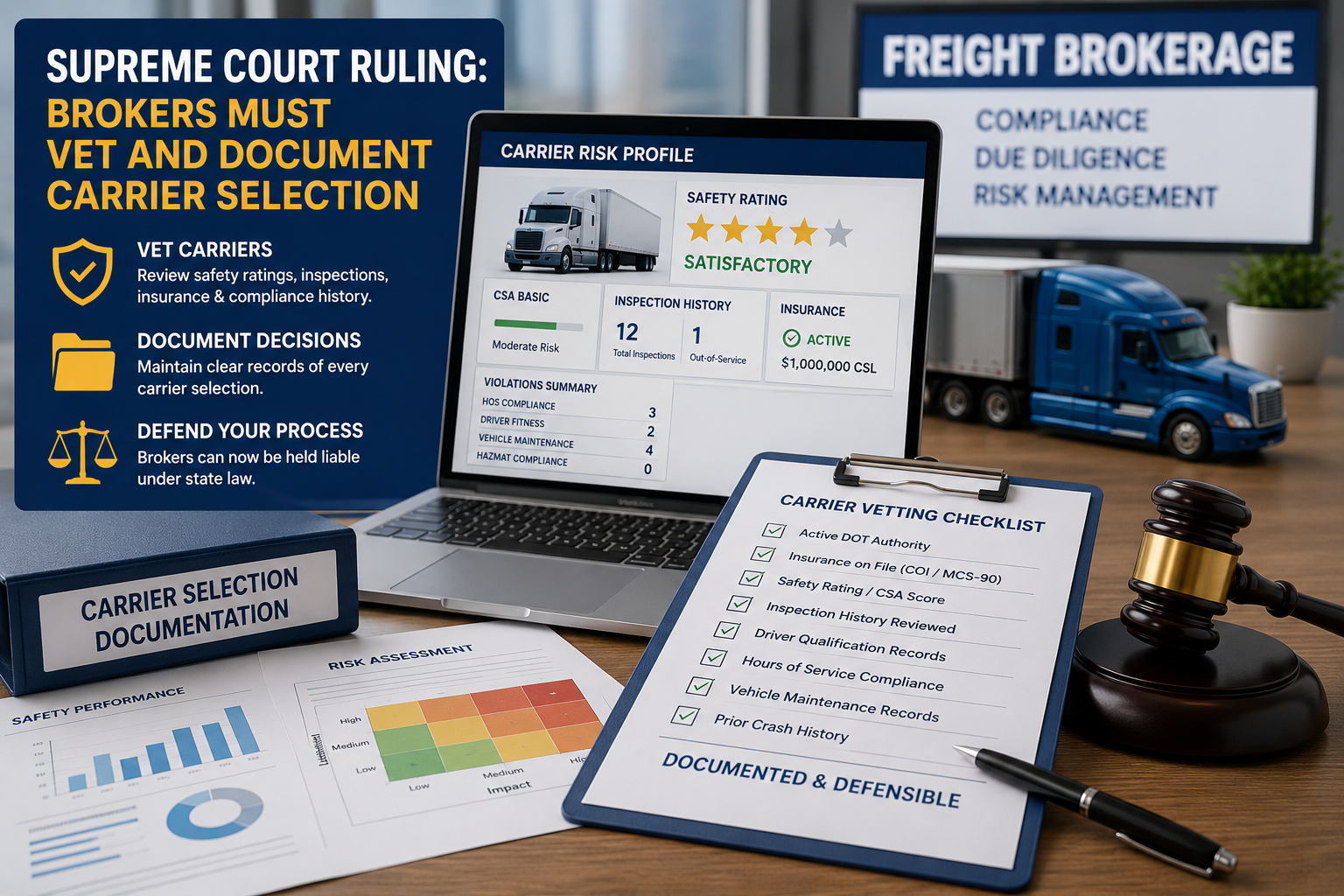
A recent U.S. Supreme Court decision is sending shockwaves through the transportation industry and could fundamentally change how freight brokers operate moving forward.
In a unanimous 9-0 ruling in Montgomery v. Caribe Transport II, LLC, the Supreme Court determined that freight brokers can no longer rely on federal preemption as a blanket defense against negligent hiring lawsuits. While the decision does not automatically make brokers liable for accidents involving carriers they hire, it significantly increases the importance of carrier vetting, documentation, and safety screening.
For brokers, carriers, and trucking companies alike, the ruling could have long-lasting effects on how freight is moved across the country.
What Did the Supreme Court Decide?
For years, many freight brokers relied on protections under the Federal Aviation Administration Authorization Act (FAAAA) to dismiss negligent hiring claims before they ever reached a courtroom.
The Supreme Court's ruling changes that.
The Court determined that state-law negligent hiring claims fall under the FAAAA's safety exception, meaning brokers can now be sued in state courts for allegedly failing to exercise reasonable care when selecting carriers.
The key takeaway is simple: brokers can no longer avoid these claims automatically. Instead, they may now have to defend their carrier selection decisions in court.
Why Is This Such a Big Deal for Freight Brokers?
The decision shifts the focus from legal immunity to operational accountability.
Previously, many lawsuits were dismissed based on federal preemption arguments. Going forward, brokers may need to prove they exercised reasonable care when selecting a carrier.
That means questions like these could become increasingly important:
Did the broker review safety records?
Were inspection histories evaluated?
Were hours-of-service violations considered?
Was the carrier's compliance history reviewed?
Were documented screening procedures followed consistently?
In many cases, the quality of a broker's documentation could become just as important as the carrier selection itself.
How Will Carrier Vetting Change?
The ruling is expected to push brokers toward stricter and more consistent vetting practices.
Basic verification of operating authority and insurance may no longer be enough. Industry experts expect brokers to place greater emphasis on safety data, inspection histories, compliance records, and documented risk assessments.
How brokers can reduce risk:
Develop standardized carrier review procedures, document every approval decision, and maintain clear records demonstrating why a carrier was selected.
The ability to show a repeatable and defensible process may become a critical factor if litigation occurs.
Why Does This Matter for Trucking Companies?
The impact won't be limited to brokers.
Carriers with strong safety records could become more attractive to brokers seeking to reduce legal exposure. At the same time, carriers with poor compliance histories may find it increasingly difficult to secure freight opportunities.
As brokers tighten approval standards, trucking companies may face greater scrutiny of:
CSA scores
Hours-of-service compliance
Driver qualification records
Inspection histories
Maintenance programs
Safety management practices
Carriers that prioritize safety and compliance may gain a competitive advantage in a post-ruling environment.
What Challenges Do Brokers Face With FMCSA Safety Data?
One complication is that many carriers do not have formal FMCSA safety ratings.
Industry data suggests that a large percentage of active motor carriers have never received a comprehensive compliance review from federal regulators. This creates challenges for brokers attempting to evaluate carrier risk using publicly available information alone.
As a result, brokers may increasingly rely on additional screening tools, carrier monitoring services, and internal review processes to supplement federal data.
The ruling places greater responsibility on brokers to identify potential red flags before assigning freight.
Could Lawsuits Against Brokers Increase?
Many legal analysts believe the number of negligent hiring claims will rise.
Plaintiff attorneys now have a clearer path to pursue claims against brokers following serious crashes involving motor carriers. In states with fewer limits on lawsuit awards, legal exposure could become particularly significant.
Industry observers also expect attorneys to focus heavily on:
Prior safety violations
Driver qualification issues
Hours-of-service violations
Maintenance deficiencies
Carrier screening procedures
In future litigation, documentation showing how a carrier was selected could become a central piece of evidence.
What Does This Mean for the Future of Freight Brokerage?
The ruling may accelerate a broader industry shift toward safer carrier networks and more rigorous compliance standards.
Brokers are likely to become more selective about the carriers they work with, while carriers may face greater pressure to maintain strong safety metrics and operational compliance.
Over time, this could lead to:
Increased emphasis on safety performance
More comprehensive carrier vetting
Stronger documentation requirements
Greater demand for compliant carriers
Increased insurance scrutiny
While the full impact will take time to unfold, many experts view this decision as one of the most significant legal developments affecting freight brokerage in decades.
How Can Trucking Companies Prepare?
Whether you're a broker, fleet owner, or motor carrier, the message from the Supreme Court ruling is clear: documentation and safety matter more than ever.
How trucking companies can strengthen their position:
Monitor CSA scores regularly
Address violations quickly
Maintain complete driver qualification files
Improve safety training programs
Document compliance efforts consistently
Conduct internal audits on a regular basis
Companies that build strong compliance cultures today may find themselves better positioned as industry standards continue evolving.
Final Thoughts
The Supreme Court's decision in Montgomery v. Caribe Transport II represents a major shift for the freight brokerage industry. While brokers are not automatically liable for carrier accidents, they now face greater responsibility to demonstrate that reasonable care was exercised when selecting transportation partners.
For carriers, the ruling reinforces the growing importance of safety, compliance, and maintaining strong operational records.
At Allcom Insurance, we help trucking companies, owner-operators, and transportation businesses navigate an increasingly complex regulatory environment. From trucking insurance and cargo coverage to risk management solutions designed specifically for the transportation industry, we're here to help protect your operation.
Call 866-277-9049 or email info@allcomins.com to learn how The Allcom Shield helps keep your business protected.